Pearson Edexcel · A-Level · Economics B
Course version: 9EB0 · Version from Sept 2015
Barriers to entry: a) Contestability and ease of entry
Contestability refers to the ease with which new firms can enter and exit a market.
Checked against the Pearson Edexcel 9EB0 specification (opens in a new tab) on .
- Point 1 of 4
- 4 key terms
Study notes
From the checked teaching notes for this specification point.
The idea
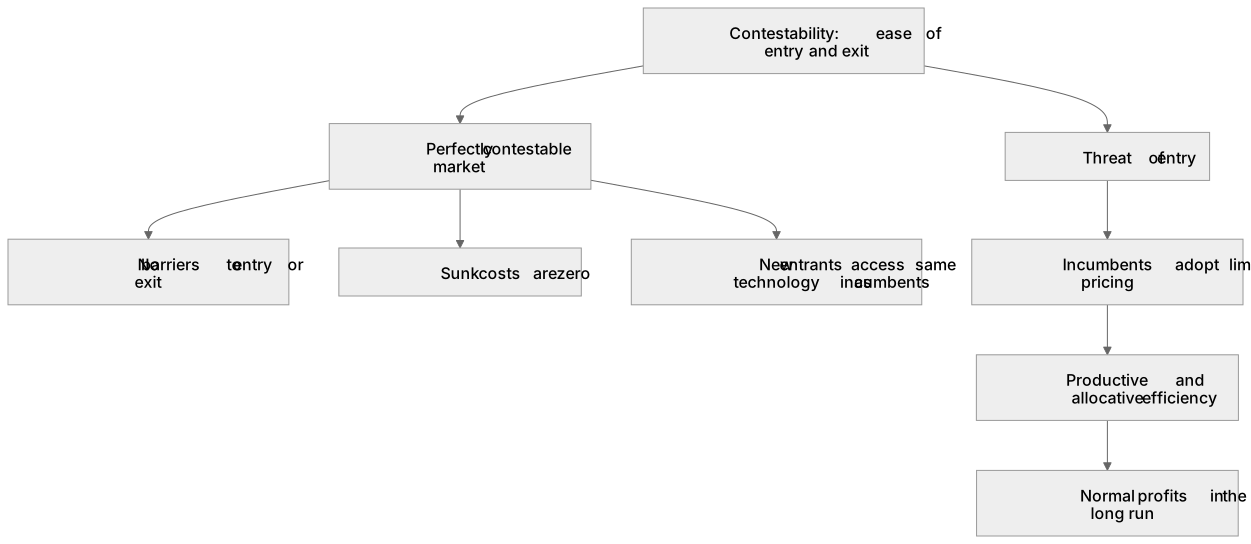
Contestability refers to the ease with which new firms can enter and exit a market. A perfectly contestable market has no barriers to entry or exit, meaning sunk costs are zero and new entrants have access to the same technology as incumbent firms. The threat of entry alone can force existing firms to price competitively (limit pricing) to deter new rivals, leading to productive and allocative efficiency even if the market is highly concentrated.
For example: The budget airline industry is highly contestable because aircraft can be leased rather than bought, reducing sunk costs and making entry and exit relatively easy compared to traditional airlines.
What earns the marks
- Define contestability as the degree of ease of entry into and exit from a market.
- Identify that perfectly contestable markets have zero sunk costs.
- Explain that the threat of entry can influence the behaviour of incumbent firms, such as adopting limit pricing.
- Recognise that high contestability can lead to outcomes similar to perfect competition, such as normal profits in the long run.
Common mistakes and how to put them right
Confusing contestability with competition.
Put it right: Competition refers to the number of firms currently in the market, whereas contestability refers to the threat of potential new entrants.
Assuming contestable markets must have many firms.
Put it right: A monopoly or oligopoly can be highly contestable if barriers to entry and exit are low.
Believing that all costs are barriers to exit.
Put it right: Only sunk costs (unrecoverable costs) act as barriers to exit and reduce contestability.
Exam tips
- Always link contestability to the concept of sunk costs when evaluating market structures.
- Use the threat of 'hit-and-run' entry to explain why incumbent firms might choose to make only normal profit.
- When analysing real-world markets, evaluate how technological changes have increased contestability by lowering entry barriers.
Try the lesson
The start of the Barriers to entry: a) Contestability and ease of entry lesson, made from checked teaching notes for this specification point.
Have a go first
Which of the following characteristics is most likely to be found in a perfectly contestable market?
Listen
Contestability refers to the ease with which new firms can enter and exit a market. A perfectly contestable market has no barriers to entry or exit, meaning sunk costs are zero and new entrants have access to the same technology as incumbent firms. The threat of entry alone can force existing firms to price competitively (limit pricing) to deter new rivals, leading to productive and allocative efficiency even if the market is highly concentrated. For example, the budget airline industry is highly contestable because aircraft can be leased rather than bought, reducing sunk costs and making entry and exit relatively easy compared to traditional airlines. A strong answer earns marks for these points. Define contestability as the degree of ease of entry into and exit from a market. Identify that perfectly contestable markets have zero sunk costs. Explain that the threat of entry can influence the behaviour of incumbent firms, such as adopting limit pricing. Recognise that high contestability can lead to outcomes similar to perfect competition, such as normal profits in the long run. A common slip: Confusing contestability with competition. Instead, Competition refers to the number of firms currently in the market, whereas contestability refers to the threat of potential new entrants. Exam tip: Always link contestability to the concept of sunk costs when evaluating market structures.
See it
Key words
Say what each word means before you turn the card.
Contestability
Try answering aloud or in your head before turning the card.
Perfectly contestable market
Try answering aloud or in your head before turning the card.
Sunk costs
Try answering aloud or in your head before turning the card.
Limit pricing
Try answering aloud or in your head before turning the card.
See every definition
- Contestability
- The ease with which new firms can enter and exit a market.
- Perfectly contestable market
- A market with no barriers to entry or exit, meaning sunk costs are zero and new entrants have access to the same technology as incumbent firms.
- Sunk costs
- Unrecoverable costs that act as barriers to exit and reduce contestability.
- Limit pricing
- Pricing competitively to deter new rivals, used by existing firms because of the threat of entry.
Label the diagram
Some boxes have lost their names. Pick the right name for each number.
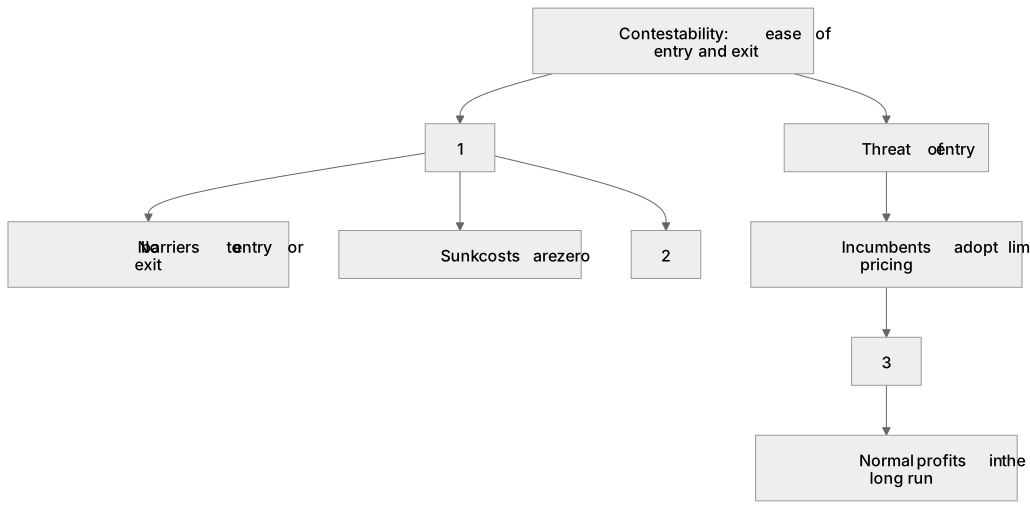
1Box 1
2Box 2
3Box 3
There is more to this lesson
The full lesson goes on to check your understanding and help you earn the marks. Create a free account to carry on, with your progress saved.
A week of Premium from your first lesson · Then the free plan continues · No card, no charge
Test your understanding of Barriers to entry: a) Contestability and ease of entry
Active recall beats re-reading. Take an instant quiz now to test what you’ve learned and lock it into long-term memory.
A week of Premium from your first lesson · Then the free plan continues · No card, no charge